Australia’s Notifiable Data Breach Scheme in effect from 22 Feb 2018

The Notifiable Data Breaches (NDB) scheme under Part IIIC of the Privacy Act 1988 (Privacy Act) established requirements for entities in responding to data breaches.

All agencies and organisations in Australia that are covered by the Privacy Act will be required to notify individuals whose personal information is involved in a data breach that is likely to result in “serious harm”, as soon as practicable after becoming aware of a breach.

For more information please read this article from ZDNet

The Office of the Australian Information Commissioner has provided detailed guidance on compliance together with a raft of NDB-related resources.

About the PMHC-MDS

Funding by the Australian Government Department of Health has been provided to Primary Health Networks (PHNs) through a Primary Mental Health Care flexible funding pool to support commissioning of mental health and suicide prevention services in six key service delivery areas:

  • low intensity psychological interventions for people with, or at risk of, mild mental illness;
  • psychological therapies delivered by mental health professionals to under serviced groups;
  • early intervention services for children and young people with, or at risk of mental illness;
  • services for people with severe and complex mental illness who are being managed in a primary care setting;
  • enhanced Aboriginal and Torres Strait Islander mental health services; and
  • a regional approach to suicide prevention activities with a focus on improved follow-up for people who have attempted suicide or are at high risk of suicide.

The Primary Mental Health Care Minimum Data Set (PMHC MDS) will provide the basis for PHNs and the Department of Health to monitor and report on the quantity and quality of service delivery, and to inform future improvements in the planning and funding of primary mental health care services funded by the Australian Government.

For more information refer to https://www.pmhc-mds.com

Best Practice Releases Lava

Best Practice Software has launched  the next version of its clinical and practice management software with over 880 development items added.
BP Lava offers a brand new reporting module, new My Health Record functionality, improvements for multi-location practices and integrated SmartForms capability from HealthLink.
See the BP Lava Knowledge Base for further information  including release notes and video tutorials that are also available via the BP (YouTube) training channel.

PCEHR renamed to My Health Record, automatic account creation trialled | ZDNet

By Asha Barbaschow

The Australian government introduced legislation on Thursday which will see its struggling personally controlled e-health record (PCEHR) system renamed and individuals automatically given an account.

PCEHR will now be known as My Health Record, and in a bid to boost recruits, the government wants to conduct trials which will see individuals automatically have an account created for them, which will require them to opt-out if they do not wish to continue with the online service.

If the trials are successful, the government will consider rolling out automatic accounts nationally.

The changes were announced today following a review that was commissioned by former Health Minister Peter Dutton in 2013, which, amongst 38 other items, recommended the e-health system be made opt-out.

At the time, it was noted the automatic account creation would only occur if the government changed the records to include demographics, current medications, adverse events, discharge summaries, and clinical measurements.

The recommendations came six months after the review was commissioned and also included renaming the system to the now donned My Health Record. At the time, the review said changing the name would “encourage more people to use the service”.

The automatic creation of accounts was originally scheduled for January 1, 2015.

In last year’s budget, the PCEHR system received AU$140.6 million in funding, with the platform pushing on in its current form whilst the government “worked on its response” to the review.

A year later, as part of its 2015-2016 Budget, the government announced it would inject a further AU$485 million into a “rebooted” PCEHR system, with the funding intended to see the rebranded e-health system go through “changes” that were not outlined at the time.

In May, Health Minister Sussan Ley said the billion-dollar PCEHR system set up by the former Labor government had seen less than one in 10 Australians sign up since its inception in 2012.

“In this modern world, where technology makes information sharing boundless, there’s no excuse for Australia not to have a functioning national e-health system, and that’s what the Abbott government’s revamped myHealth Record aims to achieve,” Ley said at the time.

“Doctors have indicated that they’re much more likely to use the system if all their patients have a record. We also need full coverage if we’re to cut down on inefficiencies created by not having one seamless records system, such as double ups with testing, prescriptions, and other procedures.”

As part of the e-health system shakeup, harsher penalties will also be given to those who misuse the data on My Health Record, with people who intentionally breach someone’s private medical records potentially slapped with civil or even criminal penalties.

Wollongong company wins Commonwealth contract to run replacement service for Medicare Local in SE NSW

Posted

Wollongong based company Coordinare has won the tender to become the Primary Health Network for the state’s South Eastern region, covering the Illawarra, Shoalhaven and Southern NSW.

The Federal Government has announced the winners of 28 new Primary Health Networks which will receive up to $900 million in government grants.

Coordinare is a not-for-profit company backed by health insurer Peoplecare, aged care provider IRT, along with public organisations Grand Pacific Health and the University of Wollongong.

CEO of Grand Pacific Health, Dianne Kitcher says the purpose of the Primary Health Networks is to replace Medicare Locals.

“Primary Health Networks will not be service providers,” she said.

“They’re much more working with Primary Health which is doctors and physios and other allied health professionals and particularly working with hospitals around how do we support hospitals to get people out of hospitals beds and receiving the care they need in the local community.”

However concerns are being raised over the decision to involve private health insurance companies in the running of the new networks.

Gawaine Powell Davies from the Centre for Primary Health Care and Equity at the University of NSW says private health insurers like Peoplecare know an awful lot about the patterns of health care people receive and have a lot of detailed information on their members, but he has questioned their role in administering public health services.

“My feeling is that the role of the Public Health Networks is on behalf of the public as a whole to try to develop the primary healthcare services, improve coordination, and do it on behalf of the whole community.

“But a private health insurance company’s first responsibility has to be to their shareholders if they are a for profit company and then to their members.

“And of course the people who most need good well coordinated health care are often those who can’t afford or don’t have private health insurance.

“It’s going to be very easy to set up arrangements which start off being for everyone and end up really favouring the people who are members of private health insurance”, he said.

Medicare Locals closure chaos

4th Oct 2014
SENATE hearings yesterday confirmed the cost and chaos caused by the Federal Government’s decision to close all 61 Medicare Locals on June 30.

The Senate Select Committee on Health this week confirmed the government would replace Medicare Locals with a smaller number of Primary Health Networks.

Member for Blair Shayne Neumann said just nine months out, no details about their number or boundaries existed, making it impossible for anyone to even tender to operate the new health networks.

“With staff unsure if they have a job, operators unsure if they have a new contract and funding already being cut, Medicare Locals are struggling to retain staff and carry out their work,” he said.

Mr Neumann said Medicare Locals were reporting they were “already losing valuable staff”.

The inquiry also heard evidence about the cost to the health budget of winding up Medicare Locals.

“The estimated costs reported by some CEOs of winding up their Medicare Locals range from around $800,000 up to $3 million,” Mr Neumann said.

Source: The Queensland Times (Oct 4, 2014) retrieved from: http://www.qt.com.au/news/medicare-locals-closure-chaos/2408201/

Peter Dutton ranked as worst health minister in 35 years in poll of doctors

By   in The Guardian

Australian Doctor magazine says 1,100 readers took part in survey and quoted one GP as saying Dutton ‘will be remembered as the dullest, least innovative and most gullible’

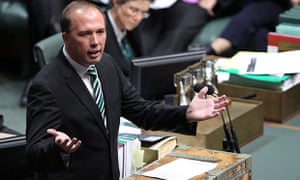
Minister for Health Peter Dutton
The former minister for health Peter Dutton – not popular among doctors, according to a poll by Australian Doctor magazine.
Photograph: Stefan Postles/AAP

Doctors have overwhelmingly voted Peter Dutton the worst health minister in living memory, according to a poll conducted by Australian Doctor magazine.

Forty-six per cent of the nearly 1,100 survey respondents voted Dutton the worst health minister in the last 35 years.

The magazine has a readership of around 20,000, mostly general practitioners and specialists.

Dutton took on the health portfolio after the Coalition won the 2013 federal election, but was moved to immigration and border protection in December’s ministerial reshuffle.

Medical groups have been vociferous in their opposition to the introduction of a Medicare copayment.

The government was forced to back down from its original $7 copayment plan, instead pursuing a $5 cut to rebates for doctors treating non-concession holder adult patients and a range of other reductions that doctors say would result in a cumulative cost to patients.

Head of the Australian Medical Association, Dr Brian Owler, said the changes had prompted “some of the angriest emails from doctors” that the organisation had received in a long time.

The Australian Doctor article quotes Tasmanian GP Dr Donald Rose as saying: “Dutton will be remembered as the dullest, least innovative and most gullible for swallowing the reforms from his thinktank … Although I am glad he has been demoted, it would have been good if he was still around to take responsibility for the current chaos he has caused.”

Former Gillard government health minister Nicola Roxon, who held the portfolio from 2009 to 2011, came in second after Dutton, securing 17% of the vote.

Current prime minister Tony Abbott, who was health minister from 2003 until the Howard government lost the 2007 election, rounded out the top three with 13% of the vote.

Guardian Australia has contacted Dutton’s office for comment.

Source: http://www.theguardian.com/australia-news/2015/jan/12/peter-dutton-ranked-as-worst-health-minister-in-35-years-in-poll-of-doctors